
As dramatic matches unfold on the courts of the All England Club during Wimbledon 2026, millions of fans are following not only the draw but also the constantly changing ATP rankings. With the year’s biggest grass-court tournament in full swing, now is the perfect time to take a closer look at the system that determines every player’s place in world tennis.
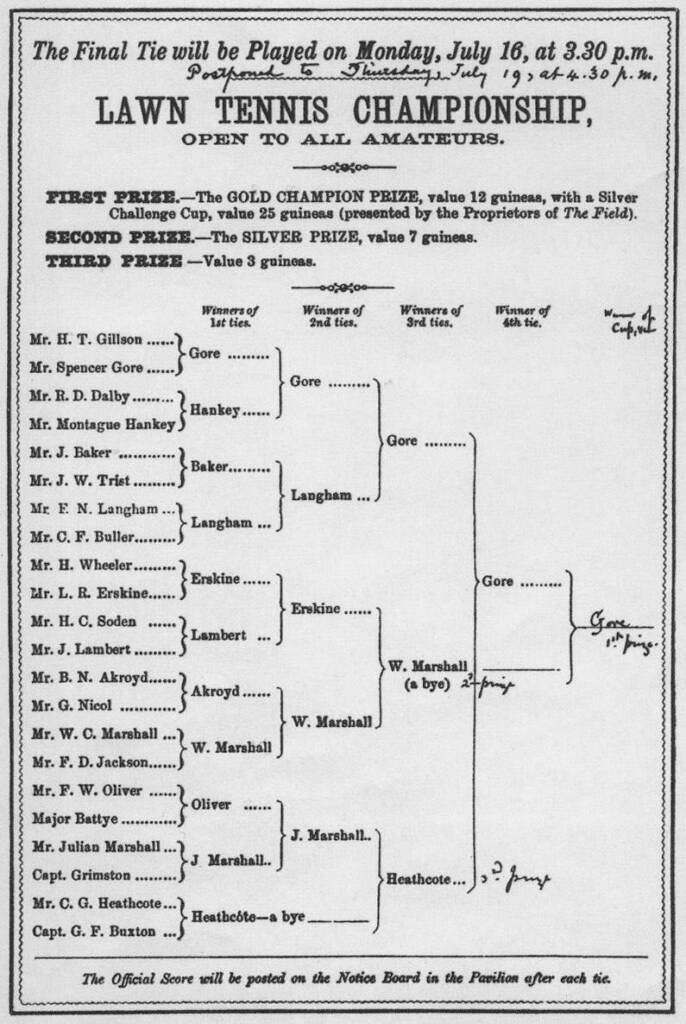
Photo: Program of the first Wimbledon Championship in 1877
The first Wimbledon Championships were held in 1877, marking the beginning of modern tennis. Yet the first objective, regularly updated player rankings did not appear until almost a century later, in 1973. Why did it take the sport 96 years before hard numbers finally replaced the subjective decisions of tournament officials?
Why does tennis need a ranking system?
Today, the ATP rankings are the foundation of the professional tennis circuit. They serve several important purposes:
- Tournament seeding. The rankings determine a player’s seeding in the draw, protecting the strongest competitors from meeting each other in the opening rounds.
- Qualification for the ATP Finals. At the end of each season, the top eight players in the Race to Turin qualify to compete for the most prestigious title of the year.

Photo: Clive Brunskill / Getty Images
- Status and prestige. A high ranking is the clearest indicator of a player’s standing in the sport. It directly influences sponsorship opportunities, endorsement deals and invitations to prestigious exhibition events.
- Commercial value. Rankings contribute to a player’s public profile and can have a direct impact on appearance fees for commercial tournaments.
- Performance analysis. Rankings provide coaches and analysts with a convenient benchmark for tracking a player’s form over time, identifying rising stars and those beginning to lose ground.
The era of personal invitations and closed doors
Before 1973, tennis was governed largely by personal judgement. Tournament organisers selected players based on subjective opinions rather than objective criteria. Priority was often given to those who could fill the stands and boost ticket sales.

Photo: The 1972 wimbledon champion, Stan Smith / Roger Jackson / Getty Images
Local players frequently received wild cards, while strong but less well-known foreign players often had to spend months writing to tournament organisers, listing their achievements and waiting for approval. It was a system that offered very little in the way of equal opportunity.
Breaking point: the Wimbledon protest
The Association of Tennis Professionals (ATP) was founded in 1972 to protect the rights of professional players. Just a year later, the sport was shaken by a major controversy.
Yugoslav tennis player Nikola Pilić was suspended from competing at Wimbledon following a dispute with his national tennis federation.

Photo: Nikola Pilić / Global Look Press / Imago Sportfotodienst
In protest against what they saw as an unfair decision, 80 of the world’s top 81 players refused to go on court.
The boycott made one thing clear: professional tennis urgently needed transparent and objective rules governing how players qualified for tournaments.
The ranking from outer space and the first World No. 1
The response came on 23 August 1973, when the ATP introduced its first computerised rankings, featuring 186 players.
The calculations were so demanding for the technology available at the time that they were carried out using computers of the aerospace company TRW in Los Angeles. The press quickly nicknamed the new system “the ranking from outer space”.
Initially, the rankings were updated once a month and displayed as large printed lists in players’ locker rooms. They later became weekly, and in 1990 the ATP adopted the modern rolling ranking system based on a player’s best results over the previous 52 weeks.

Photo: Ilie Năstase
The first ATP World No.1 was Romanian tennis player Ilie Năstase, who won 12 tournaments that season, including Roland Garros. He spent 40 weeks at the top of the rankings but never became a fan of the new system.
“I never had time to enjoy being World No. 1 because everyone around me was thinking only about how to take it away from me”, Năstase recalled years later.
How the ranking system works today
Every ranking point is the result of two factors: the category of the tournament and the stage a player reaches.
A player’s ranking is based on their 19 best results over a rolling 52-week period. Points are awarded according to tournament category:
- Grand Slam tournaments: 2,000 points for the winner
- ATP Masters 1000: 1,000 points for the winner
- ATP 500 and ATP 250 events: 500 and 250 points respectively
The modern ATP ranking system is built on a simple principle: players must defend the points they earned during the same period 52 weeks earlier. Once those points drop out of the 52-week window (with some exceptions, such as the ATP Finals), they are removed from the ranking.
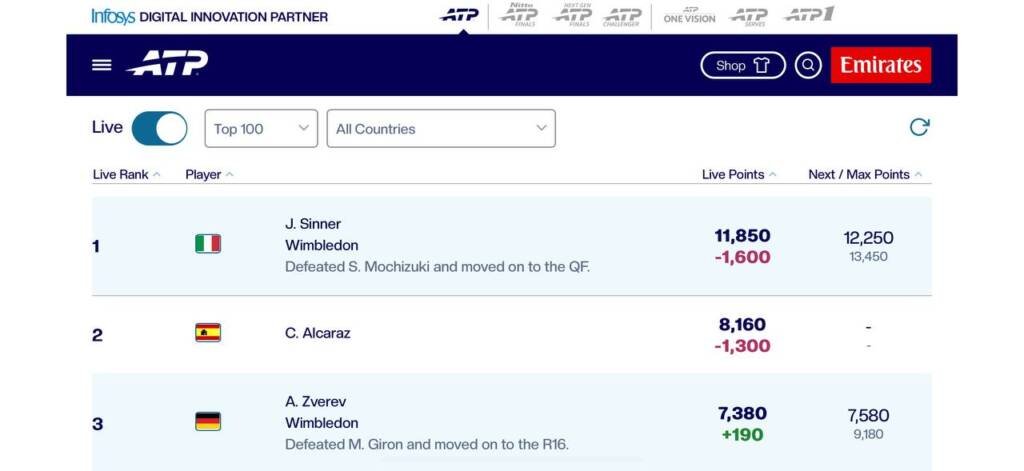
Photo: ATP ranking for July 08, 2026
This means players are constantly required to replace old results with new ones to maintain their position. Rankings are not simply about playing more tournaments.
Only a fixed number of a player’s best results count, and higher-category events always carry more weight.
If two players finish with the same number of points, ATP rules apply a set of tie-break criteria:
- The player with more points from the most prestigious events (Grand Slams, Masters 1000 tournaments and the ATP Finals) is ranked higher.
- If still tied, the player who has played fewer tournaments over the 52-week period is ranked higher.
- If still equal, the best individual tournament result is compared.
Mandatory tournaments and top-player status
For players at the top of the rankings, the rules become stricter. At a certain level, the ATP introduces mandatory events — most notably the Masters 1000 tournaments. Top players are expected to compete in them, and skipping one without a valid medical or regulatory reason may result in penalties.

Photo: Clive Brunskill / Getty Images
If a player misses a mandatory tournament without justification, they may receive a zero-pointer — a result that takes up a counting slot but contributes no points. Crucially, this score cannot be replaced by a better result from another tournament.
This is why a player’s ranking can sometimes look lower than expected despite a strong season and a high number of matches played. A single mandatory “empty” result can significantly reduce their overall total.
The system forces players not only to perform, but also to plan their schedules carefully and maintain consistency across the entire season.
Conclusion
The ATP rankings represent one of the clearest victories of structure over subjectivity in professional sport.
By replacing personal judgement with a transparent points-based system, tennis created a framework in which tournament entry and ranking position are determined strictly by results on the court.
Every player competing at Wimbledon today has earned their place through victories, ranking points and weeks of rigorous training. More than fifty years after its introduction, the ATP ranking system continues to show that in elite sport rules and results must outweigh personal preference.




/origin-imgresizer.eurosport.com/2021/05/26/3140242-64360568-2560-1440.jpg)
